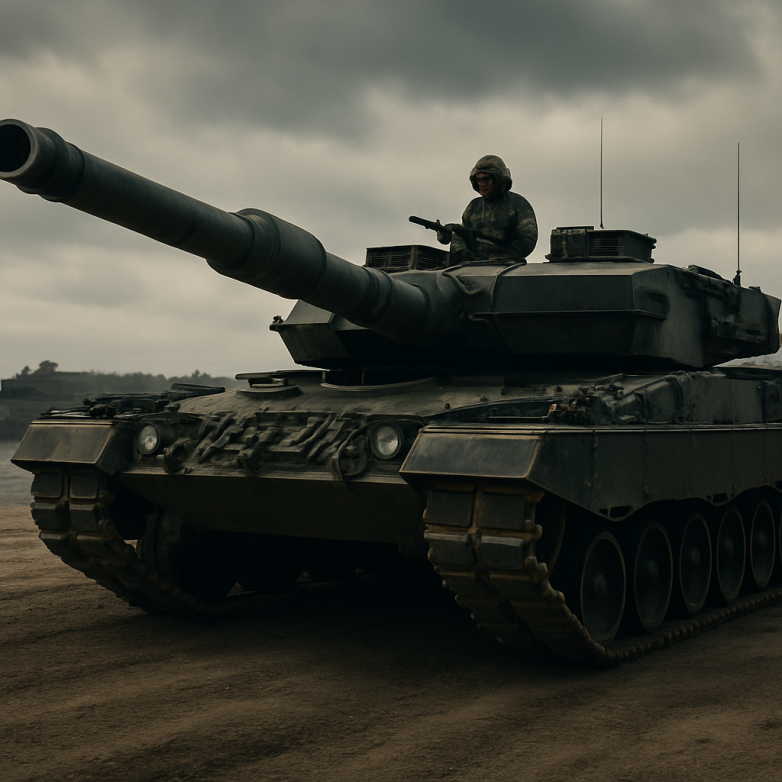
The combat weight of the Leopard 2A4 main battle tank is precisely 55.2 tonnes (60.8 short tons), or approximately 55,000 kilograms when fully loaded with ammunition, fuel, and a four-man crew. This mass represents a highly calculated engineering balance between ballistic protection, tactical mobility, and bridge-crossing compatibility across NATO infrastructure. Powered by a 1,500-horsepower twin-turbocharged diesel engine, the vehicle achieves a power-to-weight ratio of roughly 27.2 horsepower per tonne, allowing it to accelerate rapidly and reach top road speeds of 68 to 72 kilometers per hour. Understanding this weight distribution explains why the platform remains one of the most widely deployed armored fighting vehicles in modern warfare.
As heavy armor doctrine evolved through the Cold War and into modern mechanized conflicts, the 55-tonne weight class became the benchmark for Western main battle tanks. While earlier tank designs sacrificed armored protection to maintain high highway speeds, German engineers designed the Leopard 2A4 to absorb direct kinetic impacts without burdening the drivetrain with unmanageable excess mass. By replacing older spaced steel arrangements with multi-layered titanium and tungsten composite packages, the vehicle delivers heavy turret survivability while weighing several tonnes less than its modern counterparts.
Leopard 2A4 Weight, Dimensions, and Mechanical Specifications
The 55.2-tonne combat weight of the Leopard 2A4 is distributed across a torsion bar suspension system featuring seven dual road wheels per side, which limits nominal ground pressure to approximately 0.83 to 0.88 kilograms per square centimeter. This low surface pressure is essential for cross-country maneuverability, preventing the vehicle from sinking into soft agricultural soil or boggy woodland terrain. In its unloaded transport configuration without fuel, crew, or ammunition rounds, the tank weighs approximately 52 tonnes, allowing for streamlined rail and heavy-transporter logistics across standard European supply routes.
In terms of physical dimensions, the hull measures 7.7 meters in length, stretching to 9.67 meters when the main gun is pointed forward. The overall width sits at 3.7 meters, while the turret roof height clears 2.79 meters. These proportions were strictly dictated by standard NATO rail-loading gauges and European tunnel dimensions, ensuring that armored battalions could deploy swiftly across borders without requiring specialized transport overhauls. The balanced geometry between length and width also provides exceptional firing platform stability, dampening recoil forces when the main armament discharges at high elevation angles.
The mechanical heart of the platform is the MTU MB 873 Ka-501 liquid-cooled, V12 twin-turbocharged diesel engine, which generates 1,500 horsepower (1,100 kW) at 2,600 rpm. This powerplant is coupled to a Renk HSWL 354 hydrokinetic planetary transmission featuring four forward and two reverse gears, allowing the tank to reverse at speeds up to 31 kilometers per hour. This reverse acceleration provides a substantial tactical advantage during shoot-and-scoot engagements, enabling crews to retreat into defilade positions before enemy anti-tank guided missiles can complete their flight profiles.
- Engine and Transmission Mechanics: The MTU V12 diesel engine is integrated with the cooling system and transmission into a single compact power pack that field maintenance crews can swap in under thirty minutes using a field crane. Operating on diesel or alternative synthetic fuels, the engine draws from 1,200-liter internal fuel tanks to deliver an average operational road range of 500 kilometers without requiring external auxiliary drums.
- Mobility and Ground Clearance: With a ground clearance of 0.54 meters, the suspension system allows the tank to scale vertical obstacles measuring 1.1 meters high and cross trenches up to 3.0 meters wide. Deep-wading preparations enable the vehicle to traverse water obstacles up to 4.0 meters in depth using a specialized snorkel tower fitted to the commander’s hatch.
Armament, Composite Protection, and Turret Architecture
The primary lethality of the Leopard 2A4 stems from its Rheinmetall Rh-120 L/44 120 mm smoothbore cannon, which set the NATO standard for high-pressure tank weaponry. The L/44 designation denotes a barrel length equal to 44 times the 120 mm bore diameter, optimizing muzzle velocity for armor-piercing fin-stabilized discarding sabot (APFSDS) rounds and high-explosive anti-tank (HEAT-FS) projectiles. Ammunition capacity is rated at 42 rounds, with 15 rounds stored in the left-rear turret bustle behind a blast-resistant sliding door and the remaining 27 rounds secured within the front hull storage rack.
Armor protection on the 2A4 standard represents a major generational shift from early Cold War steel designs, incorporating flat-faced, vertical composite armor blocks on the front turret cheeks and hull glacis. Detailed in official KNDS Leopard 2A4 specifications, this armor matrix combines hardened steel, ceramic elements, and heavy titanium-tungsten alloys to disrupt both kinetic energy penetrators and shaped-charge warheads. While later iterations adopted external wedge armor, the vertical composite blocks of the 2A4 remain capable of defeating the majority of Cold War and contemporary battlefield threats.
Target acquisition and fire control rely on an all-digital computerized system integrated with the gunner’s EMES 15 primary sight, which incorporates an Nd:YAG laser rangefinder and a thermal imaging channel. The commander utilizes a PERI-R17A2 independent periscope to conduct hunter-killer engagements, spotting targets independently and overriding the gunner’s controls to slew the turret onto new threats. Secondary defensive armament consists of one 7.62 mm coaxial machine gun mounted parallel to the main cannon and a second 7.62 mm anti-aircraft machine gun positioned on the loader’s hatch ring.
Evolution of the Leopard Lineage: From 1A5 to the Modern 2A8
The lineage of modern German armor began with the Leopard 1 family, an entirely different design philosophy that prioritized highway speed and heavy cannon firepower over physical armor weight. By the time the upgraded Leopard 1A5 entered service with computerized fire controls, military planners recognized that 40-tonne tanks could no longer survive hits from advanced Soviet anti-tank munitions. This realization drove the development of the heavier Leopard 2 program, which moved through early trial batches like the 2A1, 2A2, and 2A3 before reaching maturity in the mid-1980s. Although the historical names Tiger and Panther echo famous World War II armor, the Leopard series was engineered from the ground up to counter Cold War threats across central Europe.
The release date of the Leopard 2A4 standard in 1985 marked the definitive consolidation of the platform, with over 1,800 units built across eight production batches through 1992. This variant introduced automated fire and explosion suppression systems in the crew compartment, fully digital fire control processors capable of computing ballistics for new propellant chemistries, and reinforced turret armor. Because of its manufacturing volume and structural reliability, the 2A4 became the foundation for subsequent European armor exports following the reunification of Germany.
As battlefield threats advanced, engineers developed heavier variants that altered both the silhouette and combat weight of the tank. The Leopard 2A5 introduced distinctive arrow-shaped spaced applique armor on the turret face, while the 2A6 replaced the L/44 gun with a longer L/55 barrel to achieve higher projectile velocities. Specialized sub-variants like the mine-protected 2A6M, the urban-combat 2A7+, the Bundeswehr’s modernized 2A7V (which weighs over 66.5 tonnes), and the active-protection 2A8 represent the ongoing expansion of the family. Despite these newer releases, the 2A4 remains widely fielded because its lighter chassis offers superior strategic mobility across bridges that cannot support 68-tonne platforms.
Combat Performance: Leopard 2A4 vs. Abrams, T-90, and Challenger 2
When military analysts evaluate whether a Leopard 2 can beat an Abrams tank in combat, the comparison centers on propulsion efficiency, armor layouts, and maintenance logistics. Both Western tanks utilize Rheinmetall-designed 120 mm smoothbore cannons and share comparable digital fire control capabilities. However, the Leopard 2A4 weighs roughly five tonnes less than an M1A1 Abrams and relies on a conventional MTU diesel engine rather than the AGT1500 gas turbine found in the American machine. This diesel powerplant consumes significantly less fuel at idle, allowing European armored units to operate with smaller refueling convoys during sustained maneuver warfare.
In direct engagements against Eastern bloc armor such as the Russian T-90 series, Western design philosophy demonstrates clear advantages in crew survivability and reverse speed. A comprehensive technical analysis of the Leopard 2A4 main battle tank highlights how the platform’s thermal optics and stabilized gun allow crews to detect and engage targets at distances up to 3,000 meters—often before older T-90 sensors can return accurate range data. While infantry fighting vehicles like the Bradley can disable enemy armor by targeting optics or tracks with 25 mm autocannon fire, the 120 mm APFSDS kinetic penetrators fired by the 2A4 are engineered to punch through heavy Kontakt-5 explosive reactive armor at combat ranges.
Comparing the Leopard 2A4 against the British Challenger 2 reveals contrasting approaches to weight and armament. The Challenger 2 utilizes heavy Dorchester composite armor that pushes its weight above 62 tonnes, paired with a rifled L30A1 cannon optimized for high-explosive squash head (HESH) rounds. The German platform, by contrast, relies on high-pressure smoothbore kinetic energy rounds and superior power-to-weight acceleration. Deployments by Canadian forces in Afghanistan and active Ukrainian service in Eastern Europe confirm that while the 2A4 can sustain hits from older anti-tank weapons like the RPG-7, it requires reactive armor overlays to survive saturated drone and missile environments.
- Western vs. Eastern Ammunition Storage: Unlike Russian T-90 tanks that store propellant carousels inside the central fighting compartment underneath the crew, the Leopard 2A4 isolates its ready-use turret ammunition behind an armored blast door equipped with blowout panels. If enemy fire penetrates the bustle rack, the explosive blast vents outward through the roof rather than incinerating the turret crew.
- Tactical Mobility Across Disputed Terrain: The 55.2-tonne mass of the 2A4 allows it to cross tactical pontoon bridges and navigate rural mud with greater agility than 65-tonne Western alternatives. Its 31 km/h reverse speed provides an essential tactical escape mechanism that older Soviet-designed tanks, which typically reverse at just 4 to 5 km/h, entirely lack.
Operational Costs, Export Operators, and Modernization Weaknesses
The unit price of a Leopard 2A4 has fluctuated dramatically over the past thirty years, driven by post-Cold War surplus sales and rising industrial replacement costs. During the late 1990s and early 2000s, European nations trimmed their defense budgets, selling surplus 2A4 tanks to partner nations for roughly $1 million to $2 million per vehicle. Today, acquiring a modernized Leopard 2A7 or 2A8 from factory production lines requires capital expenditures exceeding $15 million to $20 million per tank, making maintenance and restoration of existing 2A4 fleets an economical imperative for many armies.
Despite its proven track record, military analysts openly document the weaknesses of the German Leopard 2 tank design, particularly regarding hull ammunition storage. While the turret bustle rack includes blowout panels, 27 rounds of main gun ammunition are stored inside the left-front hull compartment next to the driver without blast separation. If a modern anti-tank mine, drone-dropped munition, or heavy anti-tank guided missile penetrates the lower front glacis, detonation of the hull ammo rack can cause catastrophic structural failure.
Today, the Leopard 2A4 remains in active service with numerous international operators, including Poland, Turkey, Spain, Canada, and Ukraine. Because these armies must continuously adapt the baseline 55-tonne tank to counter modern battlefield threats, engineers utilize open-source technical databases and simulation tools to test protective upgrades. Enthusiasts and analysts frequently consult War Thunder wiki documentation to visualize internal module layouts, armor thickness values, and mechanical performance metrics across different Leopard variants. By adding explosive reactive armor blocks and auxiliary power units to the original 2A4 chassis, global operators extend the operational life of this legendary Cold War platform well into the twenty-first century.