
Kuwait successfully intercepted a massive barrage of Iranian ballistic missiles and armed drones targeting military bases and civilian utility grids early Friday morning. The dawn attacks struck critical state assets, sparking a severe fire at a vital water desalination plant and injuring multiple Kuwait Land Force personnel. Defense Ministry spokesperson Saud Abdulaziz Al-Atwan confirmed that the national air defense networks engaged the hostile aerial targets directly within Kuwaiti airspace. While falling debris caused extensive material damage across the country, emergency protocols successfully prevented mass civilian casualties during this unprecedented aerial assault.
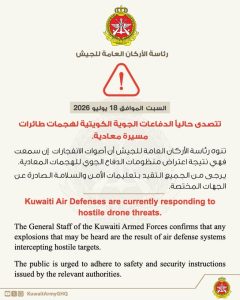
Kuwaiti authorities have deployed emergency response teams to tackle multiple fires resulting from a series of Iranian missile and drone strikes. The attacks have caused significant smoke plumes across parts of the country and damaged military facilities, power stations, and desalination plants, as air defense systems work to neutralize continuing aerial threats.
The Scale of the Iranian Strikes and Immediate Air Response
Friday’s attack marks a severe escalation in regional hostilities, beginning just as the sun rose over the Arabian Peninsula. At dawn, local Kuwait time, the nation’s early warning systems and latest radar networks detected a swarm of incoming projectiles crossing international borders. The sudden influx of hostile signatures forced military commanders to initiate an immediate air response, scrambling interceptor batteries to protect densely populated urban centers and isolated military installations. The sheer volume of the incoming fire required rapid, decentralized decision-making by defense operators manning the Patriot and localized anti-air systems.
According to the initial military reports detailing the airspace interception over Kuwait, the incoming threat matrix consisted of both high-velocity ballistic missiles and low-flying suicide drones. The drones, frequently utilized by Tehran and its proxy forces to overwhelm traditional radar horizons, were met with intense anti-aircraft fire and advanced kinetic interceptors. Witnesses on the ground reported hearing consecutive sonic booms and witnessing bright flashes as the defense grid neutralized the weapons high above the cloud layer, breaking the structural integrity of the warheads before they could reach their programmed coordinates.
Despite the high success rate of the defensive umbrella, the Iranian strikes were not entirely repelled without consequence. Several military camps bore the brunt of the drone impacts, leading to direct engagements on the ground and subsequent fires. Defense officials confirmed that multiple members of the Kuwait Land Force sustained physical injuries while executing their defensive duties during the chaos of the barrage. Medical evacuation teams quickly transported the wounded personnel to secure military trauma centers, where they are currently listed in stable condition and receiving continuous medical care.
Civilian Infrastructure Targeted: The Desalination Plant Fire
Beyond the military encampments, the aggressive operation deliberately targeted the backbone of Kuwait’s domestic survival. One of the most alarming developments from the dawn raid was the direct hit on a combined power generation and water desalination plant. In a desert nation where freshwater is almost entirely dependent on artificial desalination processes, striking such a facility goes far beyond mere material destruction. It represents a direct threat to the civilian population’s basic life support systems and the country’s overall operational stability.
The violent impact at the utility site immediately triggered a massive blaze that threatened to consume adjacent electricity-generating units. Emergency response teams, including specialized industrial firefighters and hazardous material units, were dispatched to contain the desalination plant fire before it could trigger a cascading failure in the local power grid. Dense plumes of black smoke were visible for miles, serving as a grim visual marker of the vulnerability inherent in centralized national infrastructure during a high-intensity modern conflict.
Authorities are still actively working to assess the long-term structural degradation of the affected water and power units. Civil engineers have isolated the damaged sectors to prevent further electrical hazards, while utility managers scramble to reroute power and water supplies from undamaged reserve facilities. Securing these critical utility nodes is now the highest priority for the interior ministry, as continuous operations at these plants are absolutely non-negotiable for maintaining public order and sustaining the national economy during prolonged periods of regional instability.
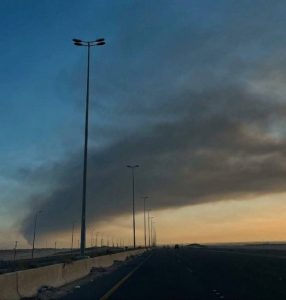
In response to Iranian missile and drone strikes that damaged desalination plants, power stations, and military facilities, Kuwaiti authorities confirmed the deployment of emergency response teams. Significant smoke plumes have been reported across parts of Kuwait, and air defense systems remain fully engaged to counter ongoing aerial threats.
Official Defense Confirmations and the Geopolitical Fallout
The official narrative surrounding the attack was delivered swiftly to prevent public panic and counter external misinformation campaigns. Defense Ministry spokesperson Saud Abdulaziz Al-Atwan addressed the nation and the international press, providing a stark, uncompromising assessment of the morning’s events. He minced no words, officially characterizing the unprovoked barrage as a “sinful Iranian aggression” aimed at destabilizing the sovereign state. His public briefing underscored the severity with which Kuwait City is viewing this breach of its territorial integrity and airspace.
Al-Atwan detailed how the military’s tracking systems monitored the hostile ballistic missiles and drones from their exact launch points until they breached sovereign borders. By maintaining full transparency regarding the incursions, the government is attempting to build a solid international case against Tehran’s aggressive posturing. The data collected by the defense ministry’s radar arrays will likely be shared with allied nations and international monitoring bodies to definitively prove the origin, trajectory, and payload capacity of the prohibited weapons used in the assault.
The violent aftermath of the mid-air collisions left an expansive debris field scattered across both urban neighborhoods and unpopulated desert zones. While the interceptors successfully shattered the warheads before they could detonate on their intended targets, the falling shrapnel caused substantial material damage to private property and commercial vehicles. Fortunately, Kuwait news outlets and local authorities have confirmed that, miraculously, there have been zero civilian casualties reported from the falling wreckage. The government has since initiated strict hazard protocols to manage the fallout.
- Immediate Hazard Isolation: Civil defense units immediately established wide security cordons around identified impact craters and suburban debris fields. This rapid isolation prevents civilians from unknowingly interacting with highly toxic rocket propellants or unexploded ordnance that frequently survive high-altitude kinetic interceptions.
- Forensic Material Gathering: Military intelligence teams are systematically collecting the shattered drone fragments and missile casings from the streets and deserts. Reconstructing these weapons provides undeniable forensic evidence of their manufacturing origins, allowing intelligence analysts to map specific Iranian supply chains and guidance system technologies.
Expanding Regional Tensions and Future Defensive Postures
This brazen assault on Kuwaiti soil is not an isolated incident, but rather a violent symptom of a rapidly deteriorating security environment across the wider Persian Gulf. As Iranian military operations grow increasingly bold, neighboring states are being forced to dramatically reevaluate their own defensive readiness and the reliability of their early warning networks. Regional defense analysts suggest that Tehran is actively testing the response times and integration capabilities of allied Gulf nations, probing for blind spots in the overlapping radar coverage that protects the oil-rich peninsula.
The international community is watching the situation with mounting alarm, recognizing that any sustained conflict in this specific maritime and terrestrial corridor threatens to choke off a massive percentage of the globe’s energy supplies. Diplomatic channels are currently operating at maximum capacity, with regional intermediaries frantically working to prevent a retaliatory spiral that could ignite a broader war. According to detailed incident tracking from international monitoring agencies, the blatant targeting of a civilian desalination plant pushes the boundaries of acceptable engagement, heavily violating established international norms regarding the protection of indispensable human infrastructure.
Looking ahead, the Kuwaiti armed forces are expected to maintain a heightened state of military mobilization indefinitely. Command centers will likely accelerate the urgent procurement of next-generation interceptor technologies and seek deeper integration with regional partners to establish a more robust, unified air defense shield. As the physical cleanup continues in the battered streets below, the invisible war in the electromagnetic spectrum above remains fully active, with radar operators scanning the dark horizon for the next wave of aggression.
Related Posts: Brenda Fricker Cause of Death: ‘Home Alone’ Pigeon Lady and ‘My Left Foot’ Star Dies at Age 81